Unfair Comparisons
Different systems are often presented under different room assumptions, mounting conditions, or reporting conventions. Side-by-side evaluation becomes unreliable before it even starts.
How physically based simulation, comparative analysis, and transparent reporting come together in one browser-based platform.
Executive Summary
Lighting decisions in controlled environment agriculture are expensive, consequential, and usually harder to analyze fairly than they should be.
Lighting decisions in controlled environment agriculture are expensive and hard to get right before capital is committed. Manufacturers make competing performance claims. Layouts are often adapted from generalized rules of thumb. And meaningful room-specific analysis is slow, fragmented, or locked behind specialized tools that most teams can’t access.
The Radiance Lighting Simulation Engine was built to change that. It is a browser-based comparative analysis tool for horticultural lighting that runs physically based canopy-level PPFD simulation across multiple lighting system types in the same room, under the same assumptions, through the same interface.
The results are surfaced as clear visual outputs, structured metrics, and documented records that teams can actually use. No specialized software. No custom simulation pipeline. Just a browser.
The Problem
When lighting decisions go wrong, it is usually because the comparison was unfair, the outputs were hard to trust, or the tools were too inaccessible to use rigorously.
Different systems are often presented under different room assumptions, mounting conditions, or reporting conventions. Side-by-side evaluation becomes unreliable before it even starts.
A heatmap without context is just an image. A metric without traceability is just a claim. Decision-makers are asked to trust outputs they cannot inspect.
Technically rigorous simulation exists, but it is typically too specialized, too slow, or too difficult to operate for commercial and operational teams.
The Solution
RLSE combines the rigor of physically based light transport simulation with the speed and accessibility of a modern web application.
Users select a room size and a lighting system, and the platform handles everything else: building the room model, placing fixtures, tracing canopy-level PPFD across a sensor grid, and generating a complete set of outputs for review.
The whole workflow runs in a browser, on any device, without configuration. That is the central product idea: rigorous lighting analysis should not require a dedicated simulation stack just to be useful.
Three Systems
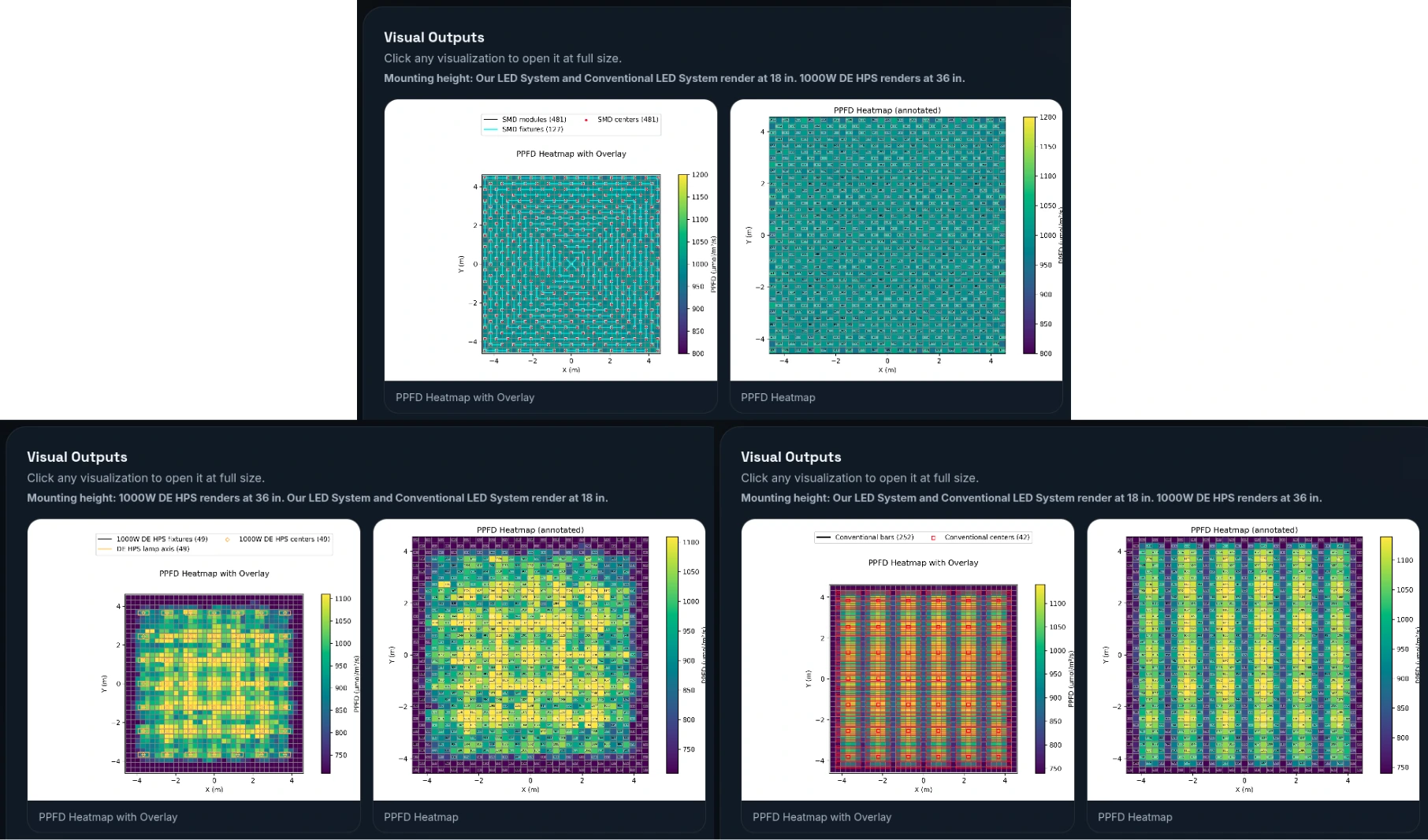
Every supported system is evaluated under the same room assumptions, output structure, and reporting logic so the comparison is honest by design.
A centered-square lighting architecture with ring-based control. It uses a repeatable kit-of-parts layout logic with concentric control zones that can be assigned different power levels to shape the final canopy PPFD field.
A practical bar-style baseline built from a physically parameterized luminaire surrogate and room-scale placement logic, giving users a realistic conventional reference for comparison.
A double-ended HPS benchmark with explicit fixture geometry, source modeling, reflector behavior, and placement logic so the comparison remains grounded in a familiar commercial reference.
Outputs
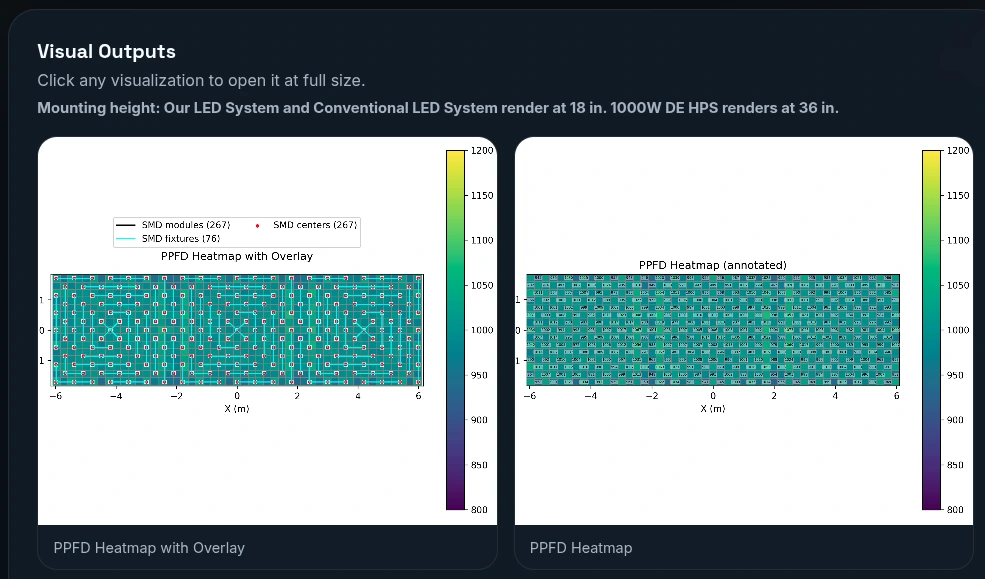
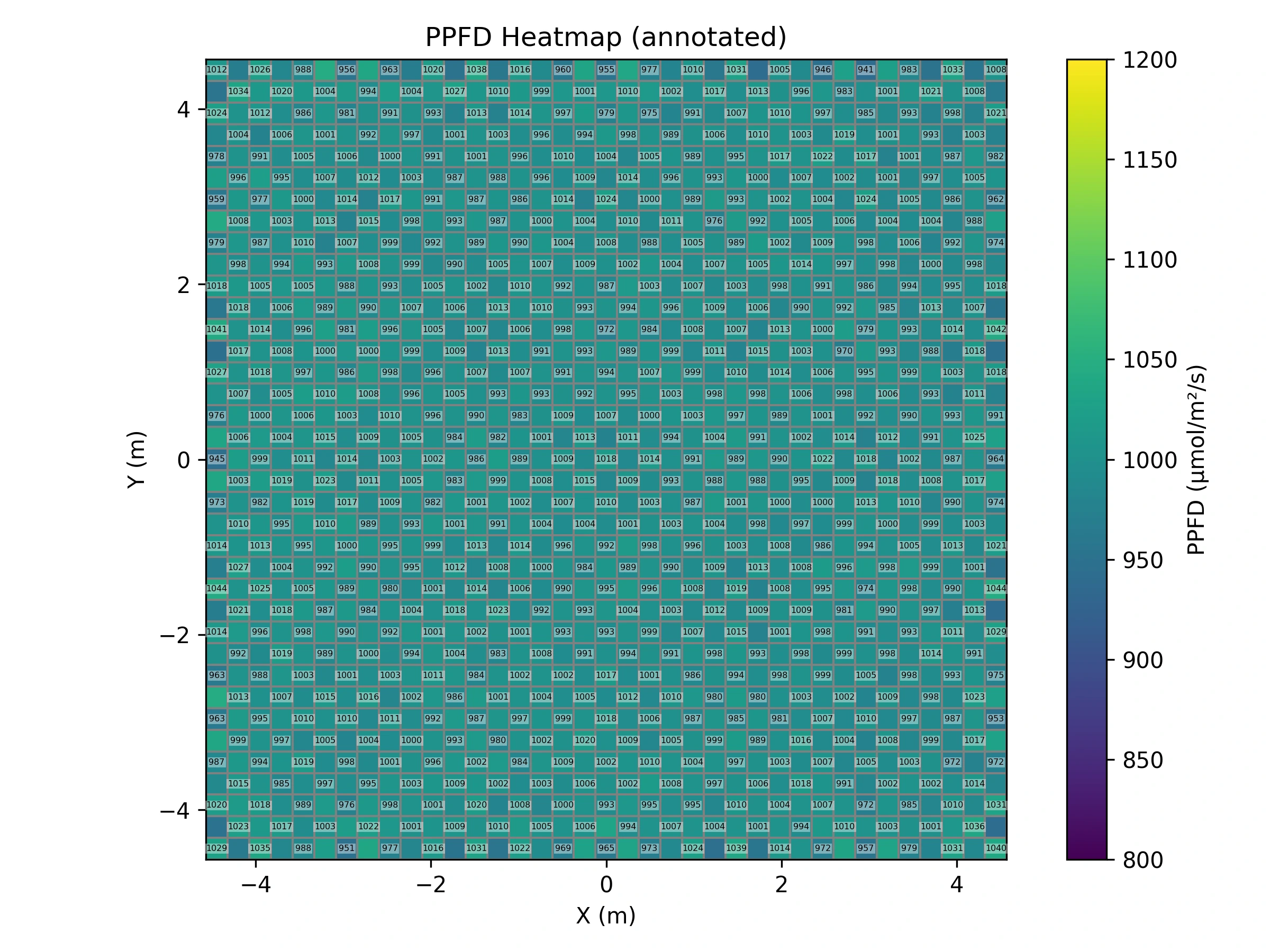
RLSE does not stop at producing a heatmap. Each run is packaged as a transparent, inspectable record of what was simulated and what the room-scale result actually looks like.
Built on Radiance
RLSE is built on Radiance, which is widely respected in lighting research and building science for its physically based treatment of light transport.
Using Radiance as the underlying engine means the outputs reflect real photometric behavior rather than lightweight visual approximations or rule-of-thumb calculator logic. For common scenarios, the platform uses a precomputed-first architecture so prepared bundles can load instantly, while still falling back to live Radiance execution when needed.
That combination matters. It keeps the browser experience fast enough for day-to-day use without abandoning the physically grounded foundation that gives the results their value in the first place.
The platform currently supports room sizes from 10 × 10 ft through 40 × 40 ft in 1-foot increments across all three modes, letting teams compare systems at practical room scale rather than only in small reference cases.
Transparency
Simulation is only useful if people can answer basic questions about what assumptions were used, what exactly was simulated, and whether the result can be revisited later.
Most tools do not answer those questions. RLSE does by treating every run as a documented event rather than a temporary screen output. The combination of run logs, structured metrics, and downloadable manifests means results can be communicated, reviewed, and defended instead of merely shared.
That is what makes the platform useful not only for exploration, but also for internal review, partner communication, technical documentation, and capital planning conversations that require more than a visual impression.
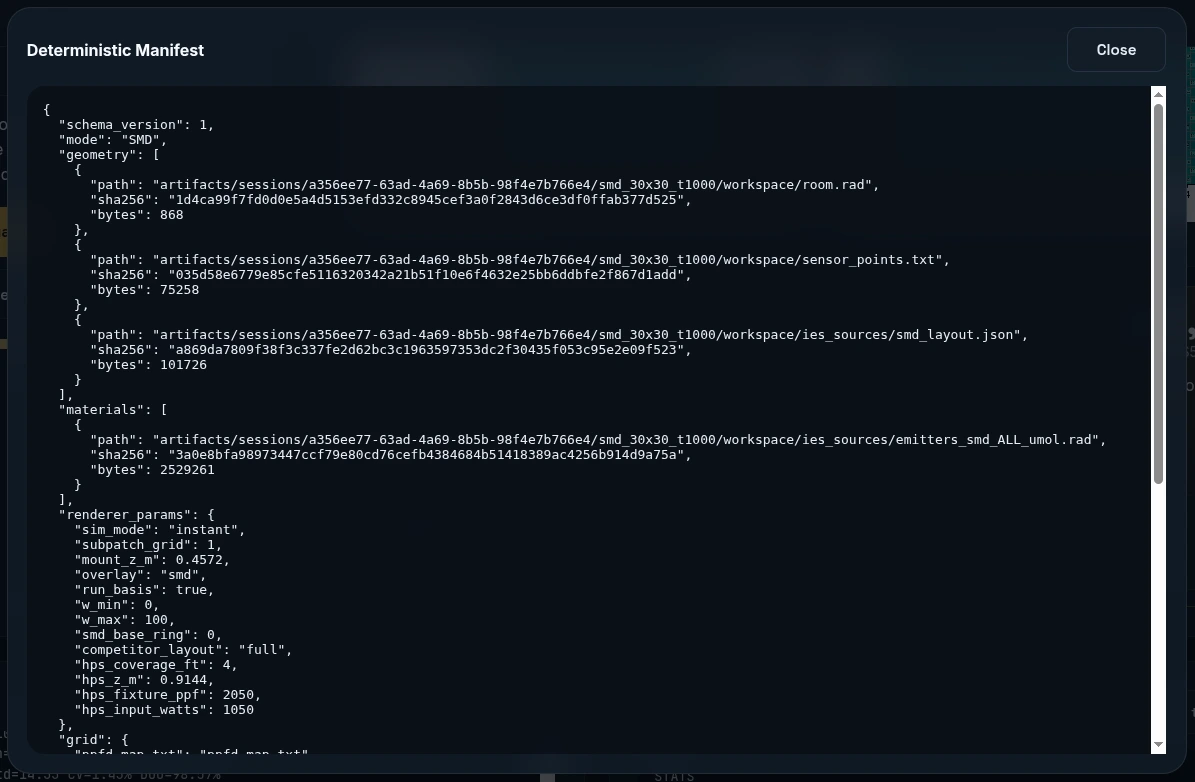
Teams can inspect the assumptions behind each run, compare outputs across systems using the same structure, and retain a technical record of the exact scenario that produced a given conclusion. That moves the platform beyond demo tooling and into decision-support territory.
Who This Is For
RLSE is designed for growers, technical teams, commercial teams, and consultants evaluating horticultural lighting at room scale.
It is especially well suited for:
It is not a replacement for physical validation. It is a rigorous pre-commitment analysis environment that narrows options, builds understanding, and supports better decisions before time and money are spent in the real world.
Conclusion
RLSE brings physically based simulation, cross-system comparison, clear reporting, and technical traceability together in a single browser-accessible platform.
It does not stop at layout generation. It does not ask users to accept results they cannot inspect. And it does not require specialized software, an IT department, or a lighting engineer to operate.
As controlled environment agriculture demands more precision, more transparency, and more disciplined capital allocation, the ability to evaluate lighting rigorously before committing to it becomes a competitive advantage. This platform was built for exactly that.
Launch the simulator, compare systems in the same room, and inspect the exact visuals, metrics, and manifests that make RLSE useful as a real decision-support tool.