White Paper

Rethinking Horticultural Lighting for Uniform Canopy-Plane Photon Delivery

A scalable framework for square and rectangular grow spaces that combines modular layout logic, concentric zone control, and simulation-driven optimization to improve canopy-plane PPFD uniformity.

Modular Layout Framework Concentric Zone Control Radiance-Based Optimization PPFD Uniformity
Read the White Paper

The Core Idea

Why average PPFD is only part of the story

In controlled-environment agriculture, the question is not just how much light is delivered. It is how evenly that light is distributed across the cultivation footprint.

Two lighting systems can report similar average PPFD values and still create very different canopy conditions. One may produce a relatively even field. Another may create bright hotspots in some regions and underlit areas in others. From an operational standpoint, those are not the same environment.

That gap matters because growers are often forced into a tradeoff. Push the whole room harder to lift dim regions, and the brightest parts of the canopy may be driven too high. Dial the room back to protect hotspots, and weaker regions drift even farther below the intended operating point.

This white paper looks at a different path. Instead of treating each room as a one-off fixture layout, it explores a scalable lighting architecture built to improve field shape, preserve control logic, and make more of the allowed light usable across the canopy.

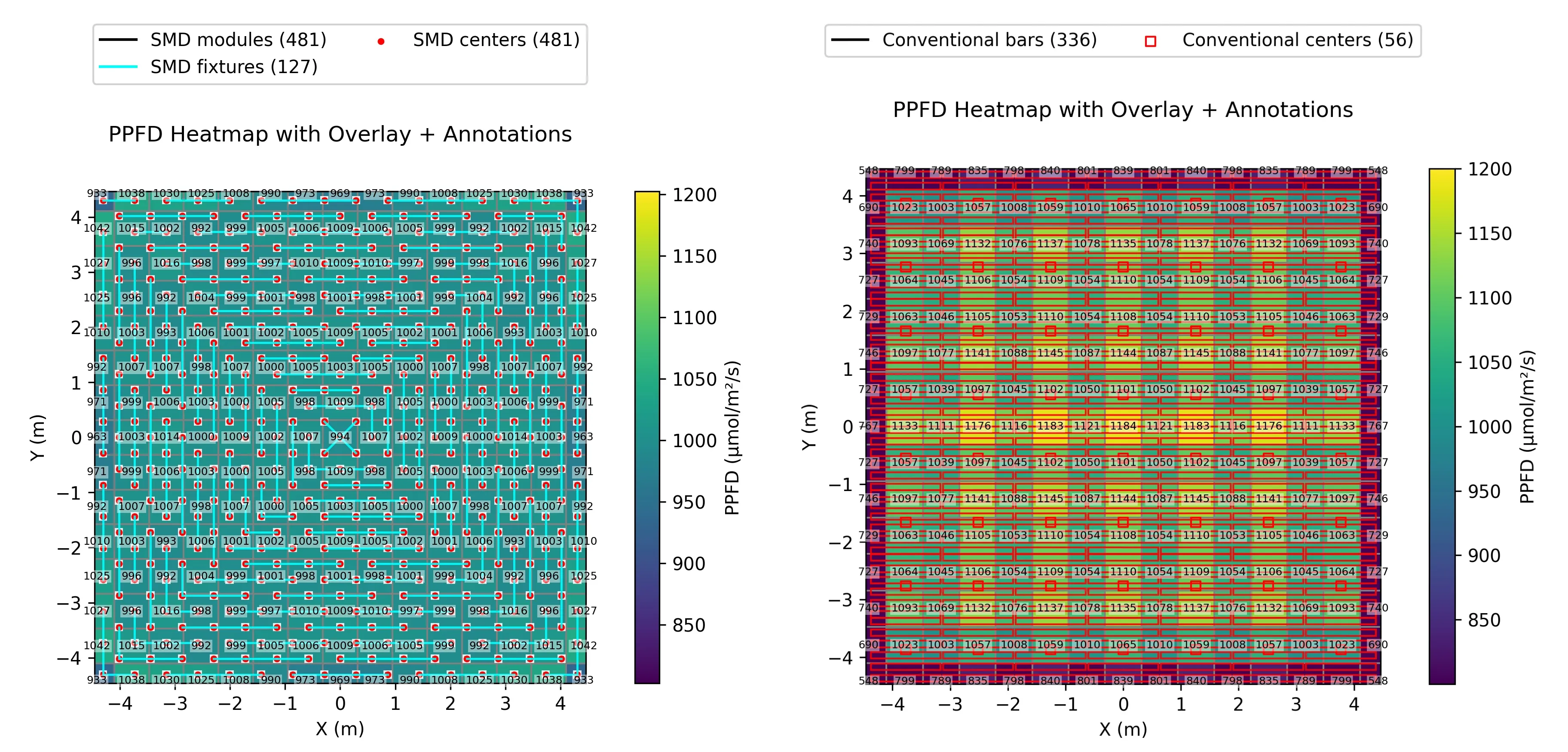
Side-by-side canopy-plane PPFD comparison showing a hotspot-dominated field versus a tighter, more uniform field.
Before-and-after PPFD heatmaps showing why average output alone can hide major differences in field quality.

The Framework

A system designed to scale with the room

The proposed framework combines modular placement logic, concentric control zones, and simulation-based power assignment. The result is a lighting architecture that can extend across square and rectangular grow spaces without rethinking the entire system from scratch.

Modular Layout Logic

The room footprint is mapped to a repeatable module grid. That means the same geometric logic can be applied across different cultivation spaces rather than creating a completely new fixture plan for every room.

Concentric Zone Control

Modules are grouped into concentric square or rectangular zones so light output can be adjusted by zone rather than by one global dimming level alone.

Simulation-Driven Optimization

A Radiance-based workflow is used to assign zone-level intensity around a user-defined mean PPFD target while reducing deviation across the canopy plane.

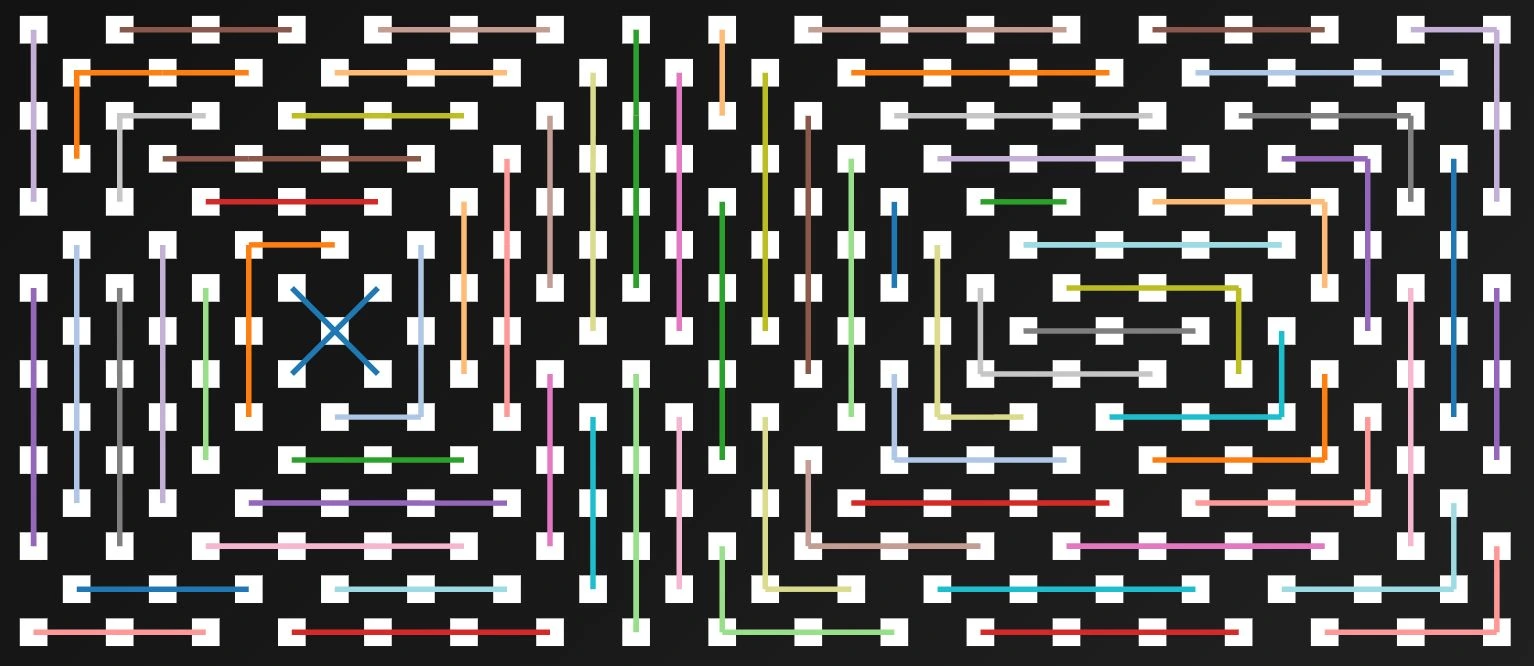
Diagram of the modular layout generator across square and rectangular rooms, showing how the same structural logic carries across different geometries.
Square and rectangular layout diagrams showing modules, rings, and room outlines.
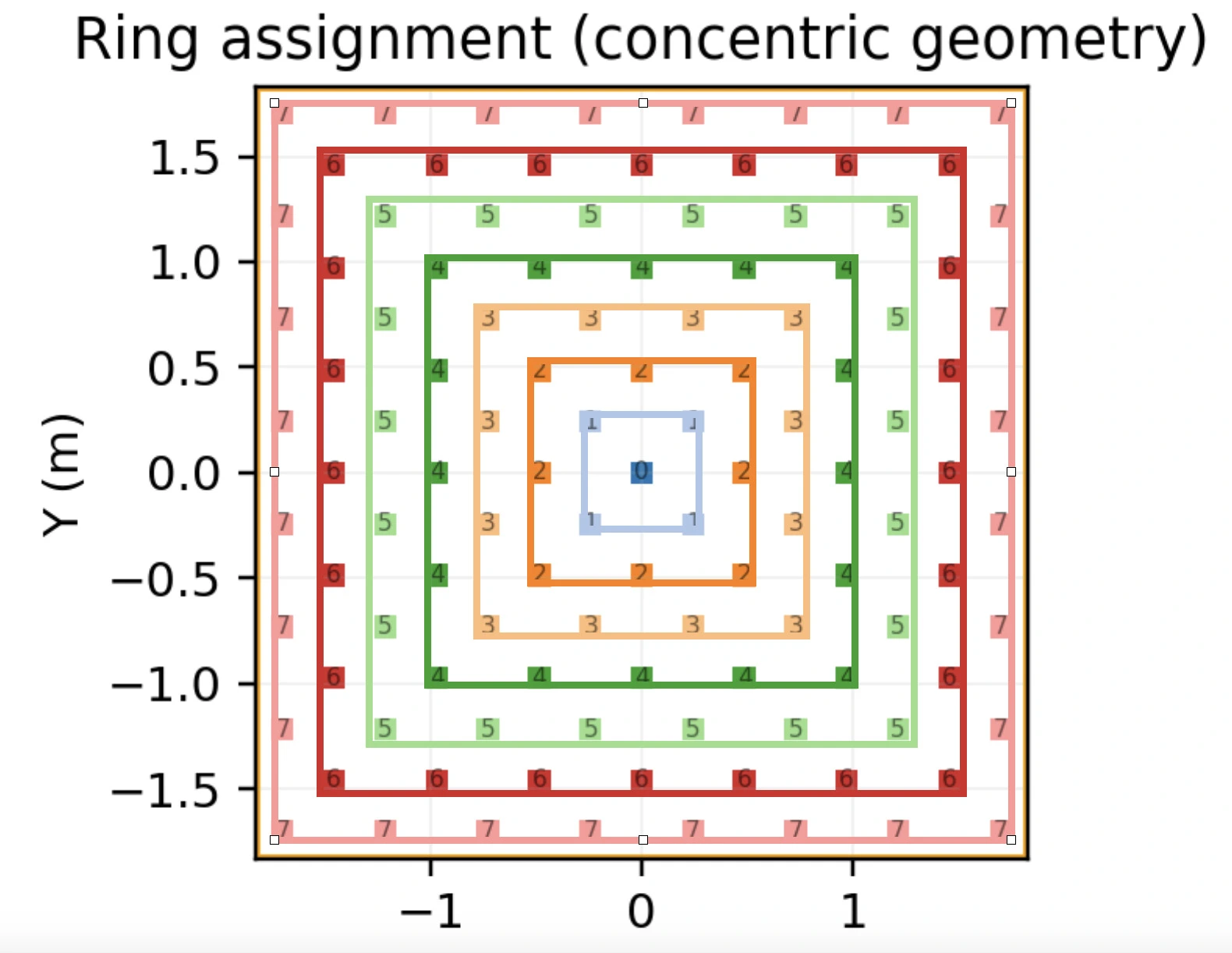
Illustration of concentric zone control showing ring-wise or zone-wise power assignment from center to edge.
Top-down zoning diagram labeled by control ring or rectangular zone.

Why It Matters

Uniformity changes what remains usable under real operating limits

In real deployments, growers often cap peak PPFD to avoid over-lighting hotspot regions. That makes field shape more than a technical detail. It directly affects how much useful light remains after the brightest areas are constrained.

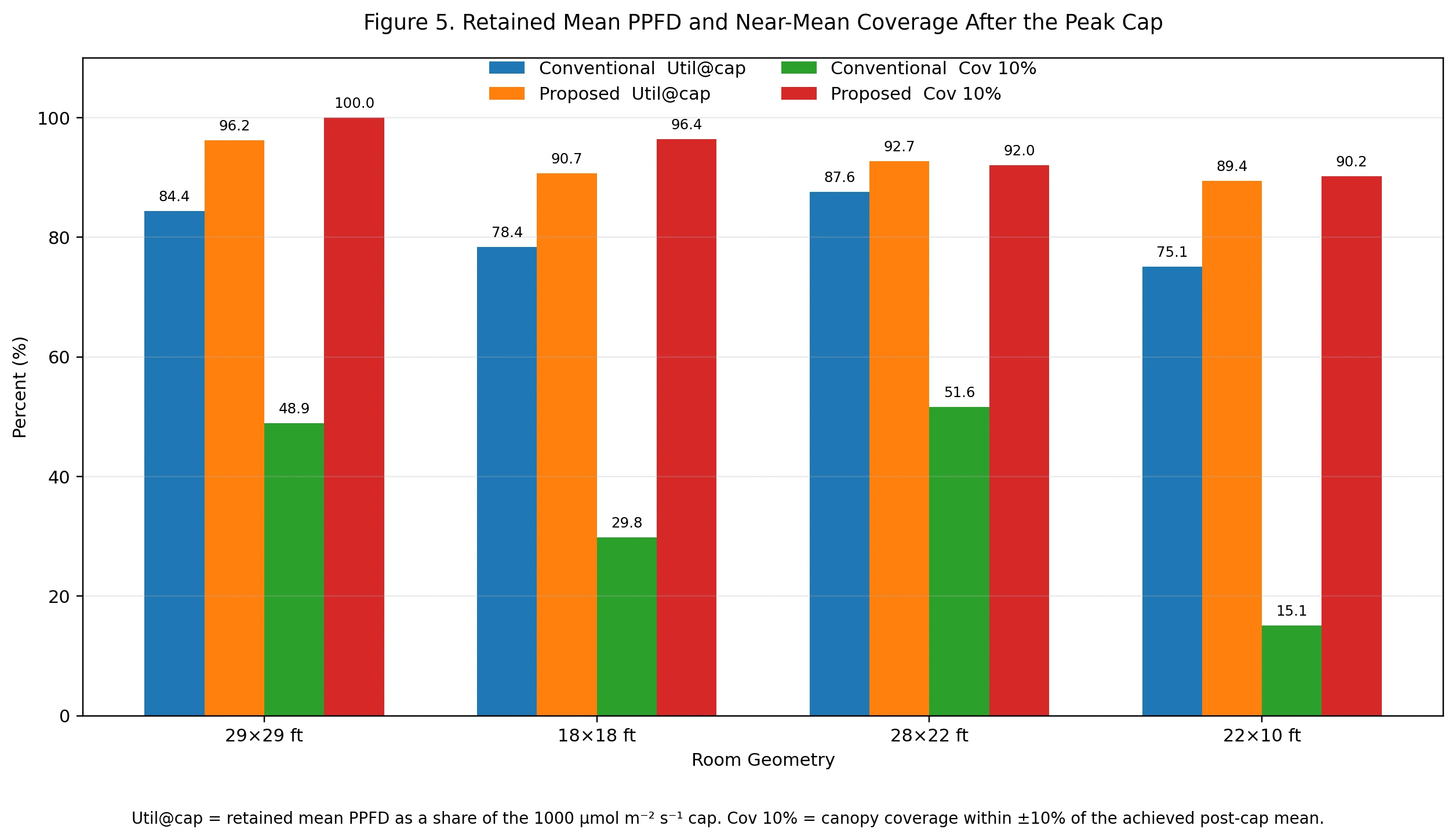
Under a common 1000 μmol m⁻² s⁻¹ peak cap, the proposed framework retained a larger share of the allowed peak as usable mean PPFD across the footprint. That is the practical advantage of a tighter field. Less of the room has to be dragged down by a few over-bright regions.

The research also showed much stronger near-mean band coverage. In plain terms, more of the canopy stayed clustered around the achieved operating point instead of splitting into bright peaks and dim gaps.

What stood out in the comparison

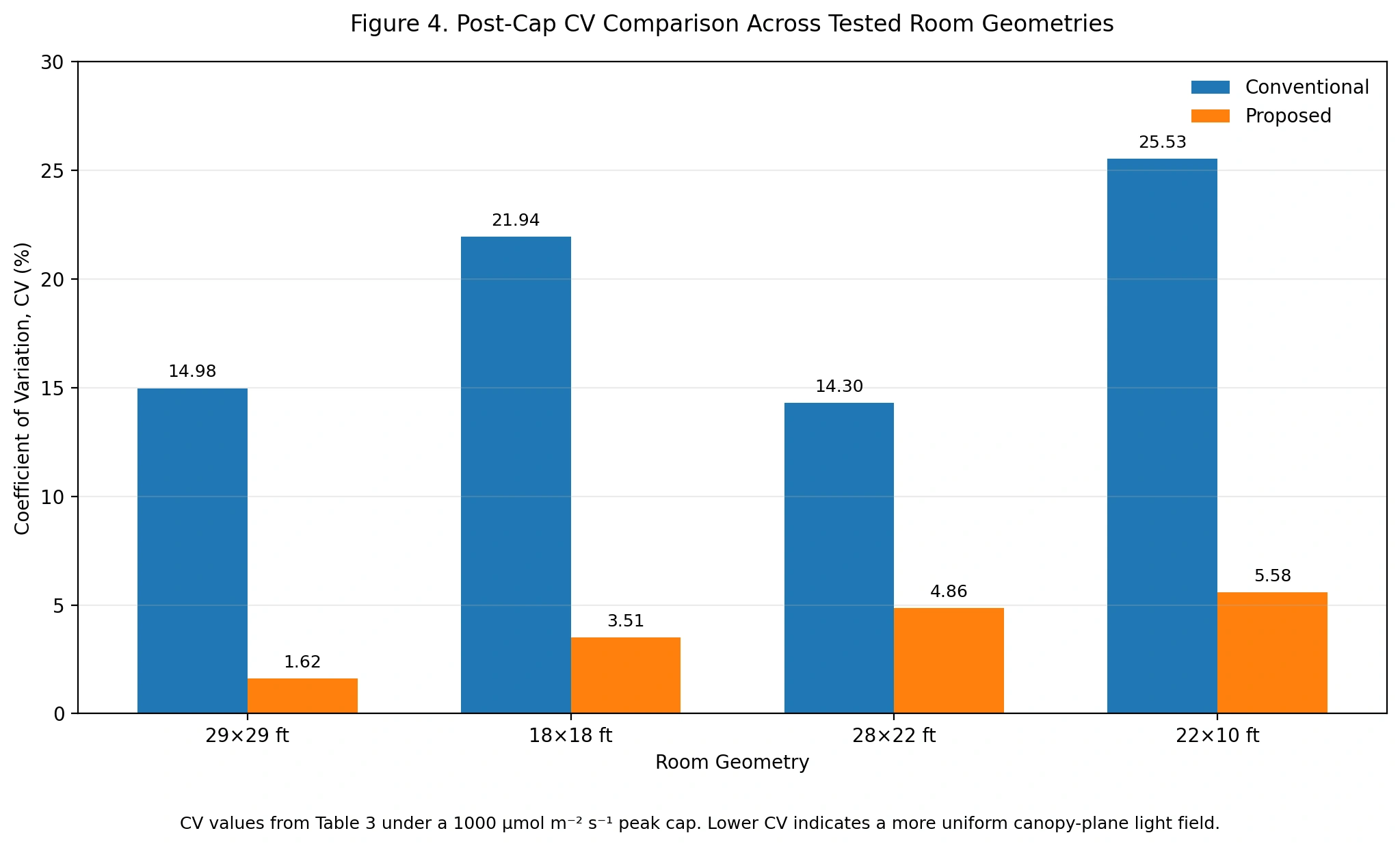
  • The proposed system achieved post-cap CV values of 1.62% to 5.58% across the tested room geometries.
  • The conventional multi-bar baseline ranged from 14.30% to 25.53% under the same peak-capped regime.
  • The proposed system retained 89.4% to 96.2% of the allowed peak as mean PPFD, versus 75.1% to 87.6% for the baseline.
  • Near-mean coverage within ±10% was substantially stronger for the proposed system across all tested rooms.
Better field structure means less wasted headroom and a more coherent light environment across the canopy.
That is the practical case for uniformity. It is not just about cleaner heatmaps. It is about how much of the room stays in a usable operating band once peak intensity is held within bounds.
Comparison chart of post-cap CV values for the proposed system and the conventional baseline across the four tested room geometries.
Comparison chart highlighting the CV gap between the proposed architecture and the conventional multi-bar layout.
Comparison visual showing retained mean PPFD and near-mean coverage after the 1000 μmol m⁻² s⁻¹ cap is applied.
Retained-mean and coverage comparison under the shared peak cap.

How It Was Evaluated

A simulation-led comparison under matched conditions

The comparison was structured so the reported differences reflect field shape and controllability, not a mismatch in operating assumptions.

The proposed framework and the conventional baseline were compared under matched room geometry, matched sensor grids, and closely matched mean PPFD conditions. Results were then reported under a common peak-capped operating regime to reflect a realistic constraint growers already care about.

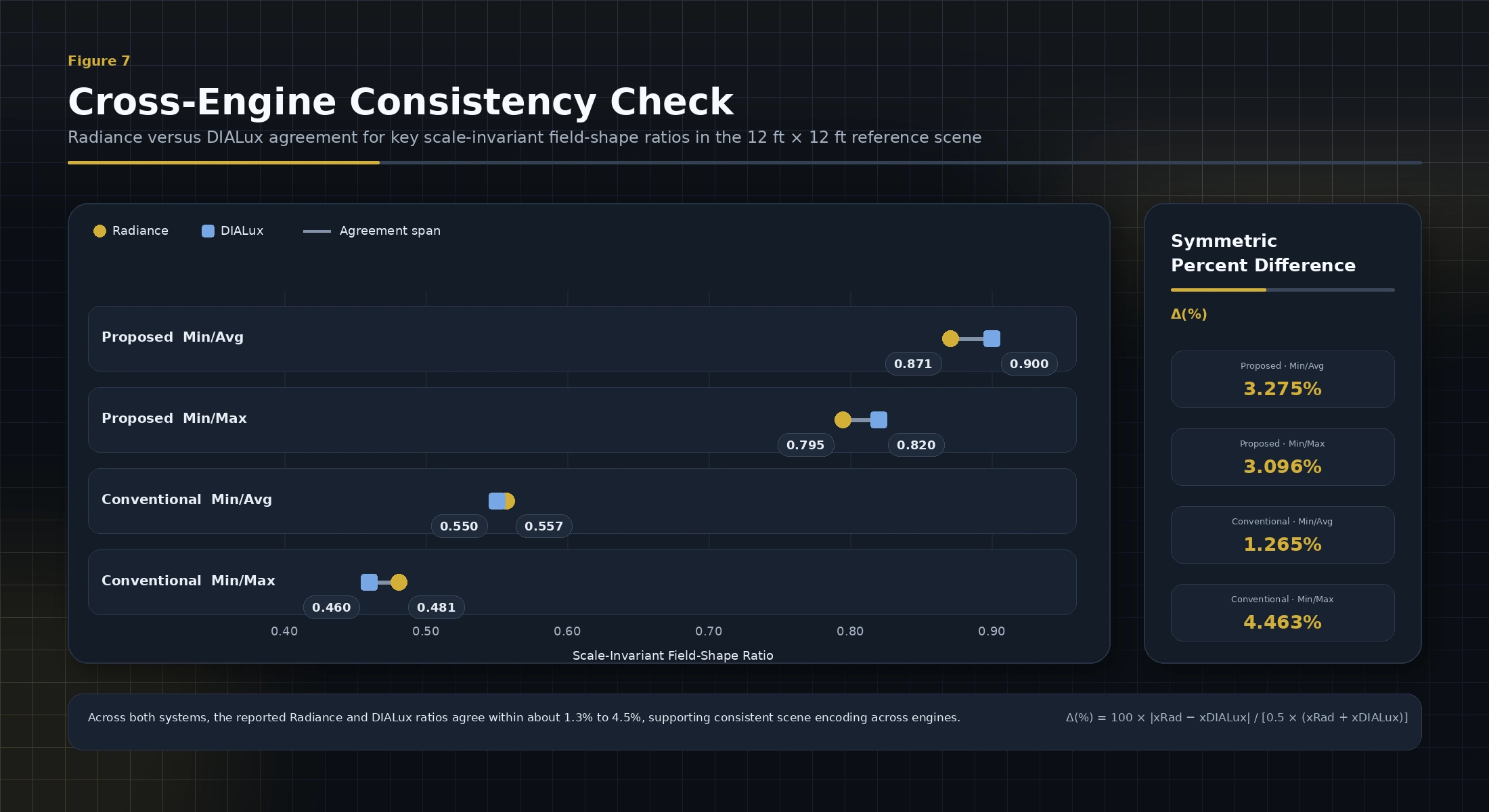
The workflow used Radiance as the primary comparative simulation engine, with DIALux used as a cross-check on a fully specified 12 ft by 12 ft reference scene. In that reference case, the field-shape ratios between the two engines agreed within 1.3% to 4.5%.

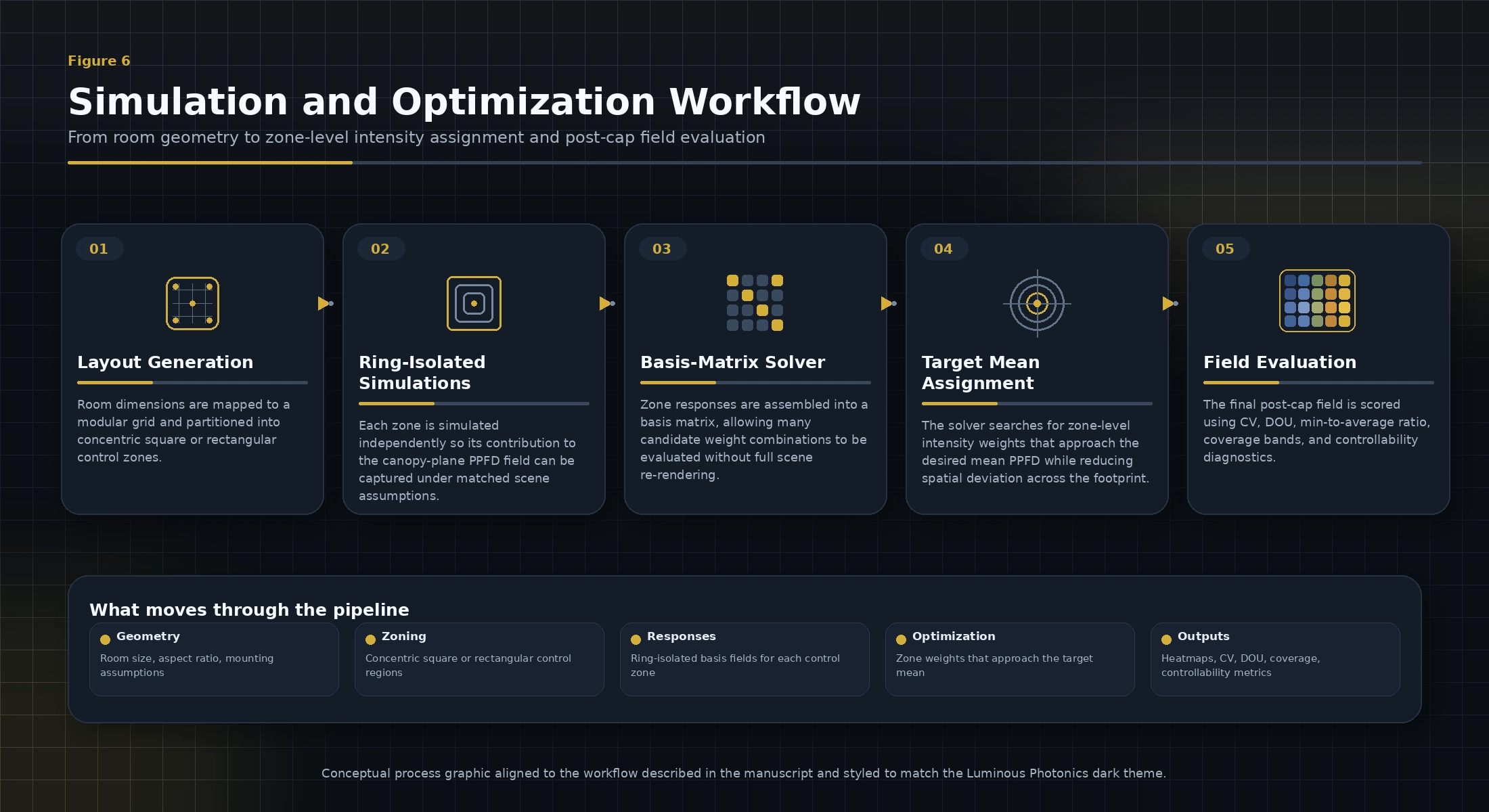
Workflow diagram showing layout generation, ring-isolated simulations, basis-matrix solver, target mean PPFD assignment, and field evaluation.
Process graphic for the simulation and optimization pipeline.
Compact comparison visual showing Radiance versus DIALux agreement for key scale-invariant field-shape ratios in the reference room.
Cross-engine consistency chart for the 12 ft by 12 ft validation scene.

Scope of this white paper

This piece focuses on physical light-distribution performance at the canopy plane. It is about field quality, controllability, and geometric scalability across representative indoor grow spaces. That makes it especially relevant for growers, system designers, and facility planners evaluating how lighting architecture influences the usable photon environment across the cultivation footprint.

What It Means

A different way to think about horticultural lighting

The main takeaway is simple. Lighting performance is not just about fixture output. It is also about how intelligently that output is distributed across the room.

Conventional layouts can work well when room dimensions, fixture dimensions, spacing, and control strategy happen to align. But when they do not, uniformity suffers and the room becomes harder to tune.

The modular concentric-zone framework evaluated here points to a more scalable alternative. It treats layout logic, zoning, and control strategy as parts of the same system. That opens the door to more consistent canopy-plane performance across different room sizes and shapes, without reinventing the design every time.

For operators, the value is straightforward. A more coherent field means more of the grow area lives near the intended operating point. For designers, it means room geometry becomes a parameter the system can adapt to rather than a constraint that breaks the layout.

Interested in the research or the system behind it?

Luminous Photonics is developing a new class of horticultural lighting architecture built around scalable geometry, zone-wise control, and uniform canopy-plane photon delivery.

Explore More Research
Pull me!